What skills do successful eCommerce entrepreneurs possess? What tricks are needed to make an eCommerce business a success?

In this post, we will look at four different types of skills needed to become a successful eCommerce entrepreneur:
- Business skills for eCommerce entrepreneurs
- Technical skills for eCommerce entrepreneurs
- Marketing skills for eCommerce entrepreneurs
- Soft skills for eCommerce entrepreneurs
Let’s get started!
Part 1: Business Skills For eCommerce Entrepreneurs
Qualitative skills, such as great interpersonal communication, may be innate, but practical management skills can be learned and sharpened by anyone.
Being passionate and ambitious are strong driving forces, but what skills are required to rise above everybody else and shine?
1. eCommerce entrepreneurs understand web fundamentals
You don’t have to be a top-notch programmer to build a successful online store.
However, you will need to learn some core web fundamentals to successfully run it – after all, your store is online.
Paying programmers and developers for every minute change may cause major cash burn, so it is essential that you learn enough to undertake minute site changes
Key skills to learn include hosting fundamentals such as domain registration, setting up nameservers, using FTP (File Transfer Protocol), deep linking, and URL redirection.
Additionally, learning HTML & CSS will go a long way in helping you make changes to your eCommerce website, add elements, and find broken pieces of code.
2. eCommerce entrepreneurs know the value of content
You needn’t be a poet, but to be a successful eCommerce entrepreneur, you need to be able to create content.
The ability to write is the ability to communicate your idea online. To convey an idea, using proper sentence formation, correct grammar, and concise information is very important.
You’ll need to learn to pen catchy taglines, create product copy that sells, social media posts, and product/service descriptions.
You will also need to learn long-form content creation for blog posts, press releases, and email marketing.
3. eCommerce entrepreneurs are well-versed in business law
This is a skill that is often overlooked. Creating a flawless business plan and acquiring funds and investors is always the top priority for an entrepreneur.
As an eCommerce entrepreneur, learning the basic commerce laws of the country/state where your business is established in will make your processes simpler
The following are a key set of laws that you need to keep a tab on:
- Tax Regulations
- Company Registration
- Intellectual Property Law
- Labour Laws
- Product Liability Law
4. eCommerce entrepreneurs are great at project management
To create a successful and sustainable eCommerce platform, project management is an utterly important and indispensable skill.
Taking care of multiple channels such as inventory, marketing, logistics, finance, and more requires sound project management skills.
Being highly underrated, it is not a skill you must overlook. Use marketing tools such as Flock, Notion, Asana, and Trello to efficiently carry out project management functions.
5. eCommerce entrepreneurs are good with number crunching
This is a clever skill that requires understanding data, being target-driven, and having solid foresight that predicts trends and patterns.
You don’t need to be an Excel whizz to calculate your break-even costs and financial projections.
You only need to be able to quickly calculate revenue predictions, track sales, manage inventory, vendor, and employee payments, and manage credit cycles.
For an eCommerce entrepreneur, this skill is supremely important to establish a sustainable online business and stay afloat.
More importantly, number crunching is a skill that an entrepreneur must continuously develop as the business grows.
This is where you will come across both opportunities to grow and deficits to cover up.
6. eCommerce entrepreneurs continue to learn and evolve
Being an eCommerce entrepreneur is all about constantly evolving. You cannot attain business sustainability and success if you stop exploring new avenues to grow and expand.
Your ability to learn and implement new skills will play a crucial role in the success and expansion of your eCommerce store.
Always being open to receiving advice from experts and new business concepts will help you achieve sustainable eCommerce growth for your business.
Always keep an open mind and remain flexible to new work processes, interesting marketing platforms, and promising growth hacks.
7. eCommerce entrepreneurs should be able to look for patterns
Another great way to develop eCommerce business skills is by observing what other entrepreneurs do. When you study multiple people, you’ll be able to find patterns of success that are helping them.
If you’re looking to learn search engine optimization (SEO), you can spend time studying the highest-ranked articles for various keywords. See how these articles are formatted, what’s included in them, and how you can stand out.
If you’re looking to create viral social media posts, you can spend time looking at the most popular posts for multiple hashtags.
Or, if you simply want to develop leadership skills, you can study the leaders you admire and note what they do differently.
Part 2: Technical eCommerce Skills For eCommerce Entrepreneurs
What does it take to build and run a successful eCommerce business? While every eCommerce entrepreneur needs to hone their marketing skills, business skills, and soft skills, there are a few technical skills that go a long way in building a successful eCommerce entity.
These technical skills are essential in order to understand the underlying layers of what makes an eCommerce business sustainable. These technical skills aren’t simply ‘good-to-have’, they’re a ‘must-have’ for eCommerce entrepreneurs.
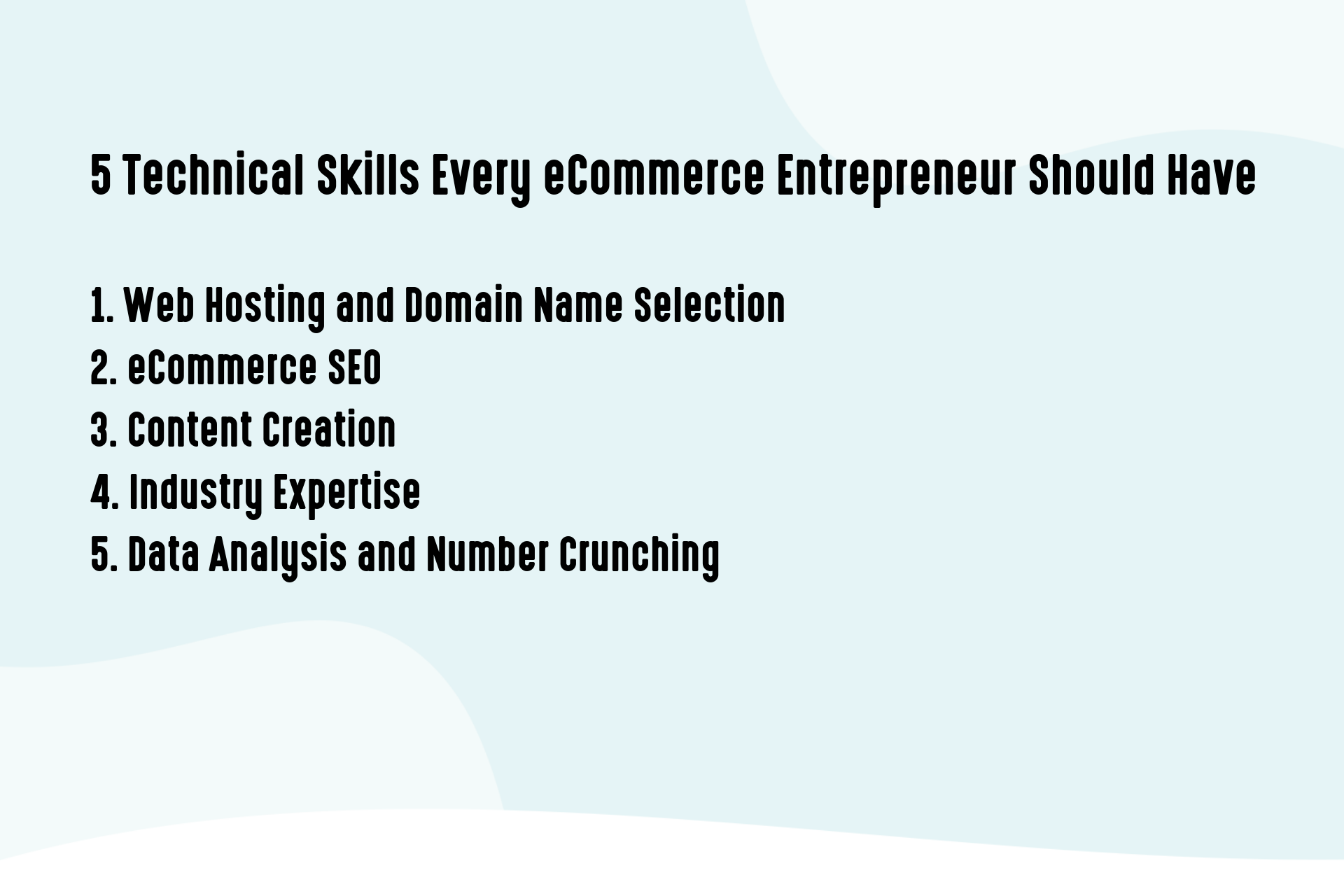
5 Technical Skills Every eCommerce Entrepreneur Should Have
1. Web Hosting and Domain Name Selection
The first of many technical skills that every eCommerce entrepreneur should have is related to web hosting and domain names. When you build your online store or eCommerce website, you need to:
- Pick a domain name for it
- Host it on a server for the world to access it.
To begin with, you need to pick a memorable and relevant domain name for your eCommerce business. Remember, your domain name is your online identity, and it doubles up as your brand name.
Ideally, you should have the basic technical skillset of picking a short, easy-to-remember, and meaningful domain name.
Consider picking a name on new domain extensions such as .store.
Once you’ve picked out a brandable domain name for your online store, it’s time to pick a website design and a web hosting solution. Things can get complicated here if you don’t know your way around web design.
While you may not be required to code, you should have enough technical skills to build a WordPress website. You can also build your eCommerce store on Shopify.
There are a couple of technical aspects to running a website that vary in terms of complexity. If you are unsure about your technical skills, consider hiring freelancers to do some of the work.
Having said that, it’s best to learn about these things and to know how things work. This way, in case you encounter any issues, you will have solutions instead of relying only on your freelancers.
These technical skills are particularly important with eCommerce and SaaS businesses.
2. eCommerce SEO
Although this is essentially a marketing skill, eCommerce SEO is highly technical. As an eCommerce entrepreneur, your primary objective is to drive more traffic to your store and boost sales.
The best way to do this is by optimizing your organic search strategies and investing in an SEO strategy.
If you aren’t doing your keyword research, indulging in content marketing, starting a blog, and constantly making SEO improvements to your eCommerce website, your business will fail to remain competitive in the online space.
Keyword research and content marketing are great places to start your SEO strategy. Additionally, you’ll want to invest in building Page Authority, Domain Authority, a responsive design, and building backlinks.
However, your SEO skills need to be dynamic, and you should understand the importance of long-tail keywords and anchor text. There are many technical aspects that you need to learn and keep track of in the constantly changing world of SEO.
This is why keeping up with it all is quite a task, especially when you’re running a business. To better cope with this, you can strategically hire freelancers or marketing agencies to keep your website consistently optimized for SEO.
Nevertheless, having the necessary SEO knowledge will help you cross-check their efforts and justify the quality of results.
3. Content Creation
Winning at eCommerce SEO is largely down to churning out and publishing quality content. Long-form blogs and FAQs that add value and are search-engine-optimized contribute greatly towards building and running a successful eCommerce business.
Furthermore, your content creation skills should include writing compelling product copies, showcasing positive reviews, and content is key to running a successful eCommerce business in today’s online environment.
Your content writing skills should pivot around creating content that drives traffic, builds trust, offers value, and attracts new leads to your business.
While investing time in writing long articles and tedious blog posts isn’t a viable option when running a business, indulging in social media posts (especially Instagram marketing), podcasts, and short videos is a great alternative.
Having said that, there is tremendous value in old-school content creation. Search engines love new content, and they use this content to push your website to rank higher.
You can start by creating a content calendar, followed by scheduling and publishing creative content.
Furthermore, frequently publishing value-driven content builds credibility. It can also establish you as an authority in your niche.
4. Industry Expertise
Before starting an eCommerce business, you need to ask yourself if you have enough knowledge and expertise in the specific niche that you’re planning on doing business in.
If not, you may want to rethink your business choices. In order to build a successful business and trust with your customers, you’ll need to be able to come across and demonstrate your expertise, knowledge, and experience in your industry.
Having said that, this doesn’t mean that you need to know everything about your niche. You can build your knowledge base with just enough of an understanding of the topic.
However, you will rise rapidly in your niche if you’ve voraciously invested in learning about your niche. For instance, if you are planning to sell exquisite and rare fashion accessories, you should know everything about it.
Where is it manufactured? What materials are used? Who are your competitors? Who are your suppliers? What’s the market for those products? And so on.
5. Data Analysis and Number Crunching
If you’re someone who doesn’t like negotiating data and numbers, you’ll have to learn to love them if you want to build a successful eCommerce business.
Why?
Because data analysis will help you understand what strategies are working and which products are selling the most.
When it comes to numbers, you’ll need to calculate your profits, the number of people visiting your store, the number of people who bounce off from your store, and so on.
This becomes interesting as you start noticing trends or inconsistencies that can help you tweak your approach and make the right decisions.
Accounting is a critical area where you will require technical skills. Now, you need not manage your own bookkeeping.
But knowing how to read and make sense of a Profit and Loss statement, a Cash Flow Statement, and a Balance Sheet is essential. Basic accounting skills will help you gain insight into the health of your business.
Furthermore, you need to understand the cost of your products and the margins to be made. Know the difference between margin and markup, and remember to calculate and include taxes, packaging, shipping, and payment gateway fees into your final cost.
As an eCommerce entrepreneur, you need to learn the basic eCommerce metrics and how to derive insights from them. Learn to use marketing performance measurement tools such as Google Analytics and Webmaster Tools, as well as advertising metrics through social media platforms.
Understand the concepts of CPC and paid advertising and learn to measure the success of your marketing campaigns. Even if you outsource this activity, having an insight into this topic will help you to better supervise and manage your eCommerce business.
These technical skills will help you to better manage your eCommerce business and ensure that you know the basic ins and outs of running an eCommerce business.
No team member or agency will be able to take you for a ride since you would already be equipped with the basics.
Part 3: Marketing Skills for eCommerce Entrepreneurs
When it comes to establishing a successful eCommerce business, there are certain tactical marketing skills every eCommerce entrepreneur must possess.
These skills are required to improve and hone the way you push your offerings to succeed in an increasingly competitive space.
Picking up from there, we’ve put together a comprehensive list of seven eCommerce marketing skills that every entrepreneur should have in order to find success.
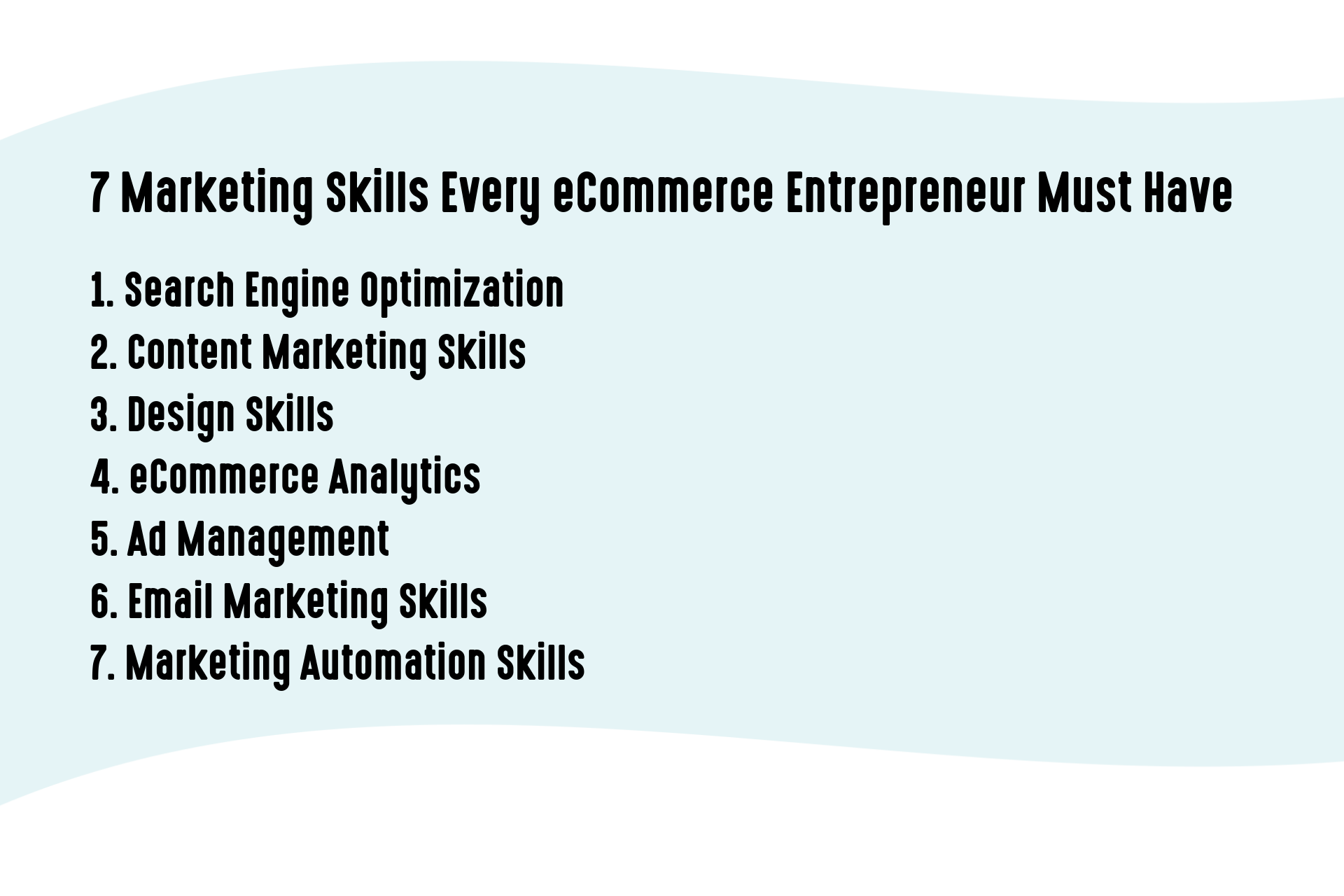 1. Search Engine Optimization
You’ve heard of SEO time and time again, but for some reason, you haven’t been able to sink your teeth into it just yet. Well, now is the time!
Search engine optimization or SEO is the process of making all the pages of your website visible to and easy for search engines to access and index.
Doing this will help your website to rank higher on search engine results.
For instance, if you are in the business of selling women’s shoes, optimize your website with relevant keywords, content, and backlinks to prompt search engines about what you do.
This way, when someone searches the internet looking to buy women’s shoes, your website page will rank higher than everyone else’s.
SEO is the pinnacle of organic marketing, and once mastered, it will outperform every other paid marketing or advertising channel.
How To Learn SEO Skills?
Here’s how you can master eCommerce SEO skills on your own:
- Read up blogs from Neil Patel, Moz, HubSpot, Search Engine Land, QuickSprout, Yoast, SEMrush, Ahrefs, to name a few.
- Read SEO guides like this one from Backlinko.
- Watch YouTube Videos and attend webinars.
2. Content Marketing Skills
The ability to write is key in eCommerce marketing.
You need to write a product copy for all your products, start a blog, write an ‘about us’ page, write FAQs, invest in a video script for your social media visuals, respond to customer requirements, product reviews, etc.
While you can hire someone to do this, you still need to train your team when it comes to the overall brand tone and voice of your content.
Not just that, content marketing is the foundation for a successful SEO strategy.
Search engines love new content, and with content marketing, you can publish relevant blogs and incorporate long tail keywords.
This activity will also help you optimize your online store for voice search.
Done well, content marketing will do wonders to drive traffic to your store and win big at eCommerce marketing.
Done poorly, and you are at risk of being looked upon as a fickle brand.
How To Learn Content Marketing Skills?
Writing and creating content isn’t something that comes naturally to most people.
However, you can improve your content marketing skills by:
- Looking at what your competitors are writing about or talking about in their blogs.
- Dive into the tone, voice, and language used in blogs and other forms of content by your industry leaders.
- Use tools such as SEMrush, Ahrefs, or Google Keyword Planner to see which keywords you should include as part of your content.
- Learn which keywords your competition is ranking high for.
- Studying what sort of videos and storylines are appealing to your target audience on social media.
- Understanding the pulse of your target market and which social media platform they spend the maximum time on.
- Promoting your content on a relevant social media platform to maximize traction.
Even if you don’t personally get involved in the day-to-day content creation for your eCommerce brand, acquiring basic content marketing skills will help you keep an eye out for your team.
3. Design Skills
The first step in starting an eCommerce business is to set up a website or online store.
Going down the line, you’ll need to design a logo and decide on your fonts and images for your marketing content.
You’ll also need to pick signature brand colors to differentiate your business from the rest.
These are important marketing skills for an eCommerce entrepreneur.
The way an ad, an article, a product brochure, or even a product page looks should be in accordance with your brand’s tone.
Not many know that the purchase decision is significantly affected by the marketing material design of your eCommerce brand and the overall web design and UX of your online store.
How To Learn Design Skills?
Given that design skills aren’t something you can acquire overnight, there are still several ways to improve your understanding of design.
- Get a design crash course through interactive tutorials.
- Experiment with tools such as Canva.
- Understand how to build a mobile-responsive website.
- Pick up a Codecademy course and experiment with code to hone your web design skills.
- Keep an eye out for the websites that you love and study what appeals to you.
- Pay attention to how your competitors or leading players are using typography, store navigation, image placements, whitespace, animation and scroll effects, colors, and design elements.
- Be open to feedback and actively incorporate it.
- Remix or recreate some of your favorite web designs or logos.
- Use tools such as Instagram and Pinterest to get new design inspirations for your website, images, and ads.
4. eCommerce Analytics
When it comes to marketing skills, every successful eCommerce entrepreneur must have the ability to examine facts and study statistics to make sound business decisions.
Marketing budgets are all about allocating funds after carefully analyzing facts and figures. This is data analysis, and it is a supremely important parameter of modern-day eCommerce marketing.
Data is the key to marketing success.
You need to know how effective certain strategies have been, which platforms work well for you and which don’t, which social media platform does your target audience spend the most amount of time, and other such vital information.
Learning this skill will tremendously help to strategize your efforts and allocate investments in order to get maximum returns.
How to Learn eCommerce Analytics?
Here’s how you can learn the art of eCommerce analysis:
- Get Started with Google Analytics’ E-commerce Integration
- Study your search traffic that comes directly from search engines like Google, Bing, and Yahoo.
- Study the campaign traffic that has been tagged by the marketer.
- Study your referral traffic that comes directly from a link on a different website.
- Read blogs on eCommerce data analytics
- Join webinars that teach eCommerce analysis
- Understand mouse tracking, conduct customer surveys, take website & exit intent polls, do an on-page SEO audit, and a shopping cart abandonment audit.
- Dive into A/B testing and user testing to see where your website lacks in terms of usability
5. Smart Advertising
eCommerce advertising must be done across multiple channels and via various forms of media.
This includes pay-per-click ads on search engines and on social media sites, display advertising, native advertising, mobile advertising, pop-up ads, video ads, and more.
As an eCommerce entrepreneur, you must possess marketing skills to understand how advertising works and how to get the maximum possible return on investment.
How to Learn eCommerce Advertising Skills?
Ad management is a challenging marketing skill to master.
But given the endless possibilities of driving sales and profits, learning everything about advertising is well worth the effort.
- Read about storytelling and how to incorporate popular ad tactics for your eCommerce brand.
- Take cues from successful ads (either from your niche or another industry vertical).
- Learn everything there is about digital marketing by joining classes, reading up on forums, and watching YouTube tutorials and webinars.
- Test your ads or ideas on a focus group or with your friends and relatives to see what works and what doesn’t.
- See what your competitors are doing and where they are excelling or lacking.
6. Email Marketing Skills
Email is still regarded as one of the most effective eCommerce marketing channels.
Therefore, marketing skills in this arena will surely help you to better reach and communicate your business and products to prospects and customers.
With email marketing, you have the chance to directly reach your target audience and demonstrate your core competency and push your brand.
How To Learn Email Marketing Skills?
- Email marketing skills aren’t all that hard to learn or acquire. Here’s what you should do:
- Learn from the emails you have in your spam folder and avoid making your emails spammy like them.
- Learn about the various subscriber acquisition mechanisms and list-building activities.
- Use tools such as MailChimp to search for the perfect templates and structures
- Take cues from compelling emails you’ve received from other brands.
- Include compelling call-to-action buttons and social media links
- Learn about video integrations and include a short, informative video
- Ensure that your landing page is mobile responsive.
- Read up blogs and watch video tutorials to improve your overall email marketing skills.
7. Marketing Automation
Marketing automation has swiftly become an in-demand marketing skill for eCommerce entrepreneurs.
Marketing automation has the power to significantly reduce marketing expenses, boost conversion rates, increase average order value, and even improve shopper experience, in some cases.
As a skill, marketing automation involves managing core marketing functions and processes in automated platforms.
Marketo, HubSpot, Klaviyo, Keap, and Mailchimp are examples of marketing automation tools.
How To Learn Marketing Automation Skills?
Marketing automation is a skill you must learn in order to streamline your marketing activities. Here’s how you can do it:
- Find the automation tools that you think will work for your business and master them.
- Read about them on blogs and watch tutorial videos on YouTube.
- Refer to guides for additional assistance.
Building an eCommerce business is challenging given the mammoth costs and ingenuity required to sustain in this competitive space.
However, promotional activities can be simplified if you have the necessary marketing skills to lead your team and to strategically build your business.
Part 4: Soft Skills for eCommerce Entrepreneurs
While mastering marketing skills and conquering business skills are imperative to running a successful eCommerce business, there are a few soft skills every eCommerce entrepreneur should have.
Learning soft skills will not only help to build a successful eCommerce business but also a successful leader and a well-rounded individual.
As an eCommerce entrepreneur looking to make the most of the available resources, soft skills will enable you to extract the most from your team, share ideas, connect with stakeholders, and convince clients, partners, and customers, among other advantages.
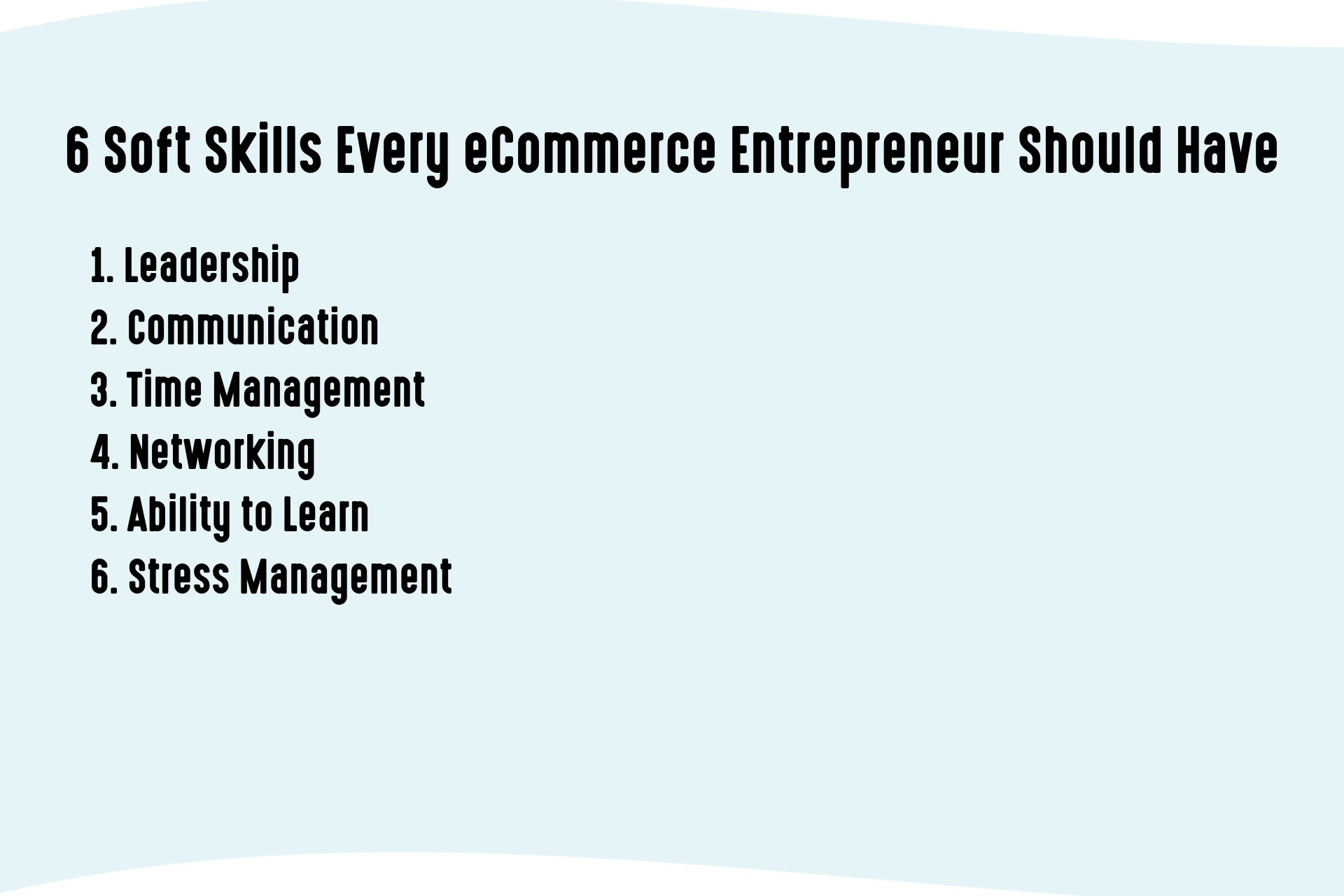
6 Soft Skills Every eCommerce Entrepreneur Should Have
1. Leadership
There’s a stark difference between leading people and giving orders. As an eCommerce entrepreneur, you need to lead people by understanding them and inspiring them.
As Gary Vaynerchuk says, “As a leader, you need to work for your employees”. Good leadership is all about empowering your people to feel safe, strong, and included in the processes that directly affect their lives.
You need to understand your team members, who they are, what their individual career goals are, where they want to go, what problems they have, and what’s bothering them.
Address their needs and connect with them so that they know that you have their back.
Simply delegating work and assigning tasks won’t make you a great leader. You need to be self-aware and understand who you are, and then progress into investing time and effort in understanding your team.
Among all the soft skills an eCommerce entrepreneur should have, being a good leader is critical to business success.
2. Communication
As an eCommerce entrepreneur, you need to develop your communication skills. You need to be able to communicate effectively and clearly with your investors, partners, and peers.
Your employees need to understand your vision, goals, and overall mission of the business. Your clients should understand your value proposition and the utility of your products.
This includes mastering all forms of communication from one-on-one telephonic conversations to in-person conversations, group conversations, written communication, email, and social media messages.
Some of the common communication skills include:
- Listening
Listen to inputs from your stakeholders, feedback from customers, and suggestions from prospects. This will help you perfect your offering and enable you to come across as a constructive person who listens and understands.
- Writing
Learn the language and tone of your industry. Stick to a brand tone and be polite and courteous in your written communication. Respond gracefully to any social media trolls. Avoid getting into a nasty battle of words.
- Presenting
Clearly explain what your business is about, what you offer, where you want to go with it, and what your aspirations and business goals are.
- Speaking
Speak with clarity and precision. Construct your thoughts and speak to your team, stakeholders, and anyone else with a sense of intelligibility and fluency.
These skills will enable you to share your message effectively and help people understand and relate to your vision.
Communication skills make for one of the most important soft skills that every eCommerce entrepreneur should have.
3. Time Management
Another one of the most important soft skills every eCommerce entrepreneur should have is time management.
As an eCommerce entrepreneur, especially if you’re running the business single-handedly, there is a high probability that you are swamped with tasks and to-dos.
You need to know how to manage your time if you wish to find success.
Categorize and compartmentalize your tasks and duties based on order of importance.
Delegate or outsource where necessary. Don’t try to do everything on your own and set time aside to read and respond to emails.
A critical element of finding success depends largely on knowing how to use your time.
Furthermore, you should invest in developing a discipline that enables you to stick to your timetable.
Doing this will help you keep your mind clear, make decisions with ease, and maximize your productivity.
When it comes to developing time management skills, you can truly push yourself to the next level and achieve more.
4. Networking
A supremely important skill as an eCommerce entrepreneur, or for that matter, any entrepreneur, is to actively network with people.
Everyone from clients to prospects to partners to suppliers to marketing agencies to investors to enthusiasts, and anyone who can be beneficial to you in growing the business.
However, networking isn’t simply about meeting new people over dinner and beer and collecting a meaningless stack of business cards.
It’s about building strong relationships.
This means you should go the extra mile and make friends. Not just contacts or mere acquaintances.
Networking is about building strong relationships and making friends with people in your industry or ancillary industries who are also doing something unique and who can provide value to your business.
Similarly, you need to find ways to provide them with as much value as you possibly can.
Networking is a soft skill that is largely dependent on mastering the communication skills mentioned above.
Among all the soft skills every eCommerce entrepreneur should have, learning how to network and actively building relationships is a skill that will do wonders for your eCommerce business.
5. Ability to Learn
As an eCommerce entrepreneur, you’re going to witness a rollercoaster of a journey. There will be ups and downs, and this is where the ability to learn will come in handy.
An entrepreneur needs to have the desire to learn and keep an open mind when it comes to learning new concepts.
There is a high chance that your employees or junior team members might have some fruitful inputs.
If you, as an individual, can learn from anyone, in any situation, about anything, then you will find it easy to find success.
Learning from failure can help expand one’s horizons, knowledge, and understanding of business.
The ability to learn is a set of soft skills every eCommerce entrepreneur should have in order to grow as an individual, a leader, and a business owner.
6. Stress Management
This soft skill is two-fold. However, if you think a 9-5 job was stressful, you’re in for a real shocker when you start your own business.
Firstly, you must learn to center yourself and keep stress at bay.
From meditating to better time management, do what suits you and learn to be calm, patient, and resilient.
Secondly, as an entrepreneur, it’s your job to be that solid core for your team.
The fact of the matter is that you are running a business, and there will be internal conflicts or issues that could cause stress and negativity.
You need to be able to rationally manage other people’s stress and resolve any issues that are plaguing your team.
However, if you are under stress, you need to fix that first.
Most entrepreneurs never learn how to manage other people’s stress.
Instead, they resort to resentment for their team instead of acquiring emotional intelligence.
Stress isn’t always a bad thing because stress is just stress. How you deal with it and manage it is down to your management skills and emotional maturity.
This is why learning how to manage stress is a set of soft skills every eCommerce entrepreneur should have.
These are soft skills every eCommerce entrepreneur should have in order to build a truly flourishing business and a solid personal brand.