You are choosing a name for your online store. A .store domain says what you do in the address itself, and you can picture it on your packaging, ads and social profiles. But before you register it, you have a fair question: Will shoppers trust it?

Trust is not something a domain extension can declare for itself. You can check how it is used, how its operator handles abuse and whether your own store gives people the signs of a real business. You can also look at what the available research says about branding, search traffic and sales.
Who is responsible for .store? Radix is the registry that owns and operates the extension. You may buy your domain through a store platform or registrar, but Radix sets the rules for the extension and handles abuse at the registry level. Its policies and reporting process are part of what you can evaluate before buying.
Here is a practical way to do all of that before you buy.
Key takeaways
- .store can make an online store’s purpose clear in a short, brandable address.
- A trustworthy-looking name needs a trustworthy setting. Check independent abuse data and the registry’s published policies.
- The choice of an extension can have potential benefits in search rankings. As data shows, there are significant SEO benefits in how people understand and respond to a relevant URL.
- Wix’s revenue data and a commissioned search experiment offer encouraging results for .store, with important limits on what they prove.
- Your domain should match your brand, and your store must back up the promise with real contact details, clear policies, and a reliable checkout.
Why do shoppers pay attention to a store’s address?
On September 18, 2026, Fox News reported on DoppelCart, a large network of fake online stores that security company Nebty investigated. Researchers linked roughly 119,000 domains to the cluster, found more than 105,000 shops active in scans cited by Fox and identified 44,182 brands being imitated. Examined checkout pages could send card details and one-time bank codes to attackers in real time. These are figures reported from the September investigation, and Nebty’s searchable database may be updated. Shared infrastructure does not establish that one person controlled every shop.
Fox’s first piece of advice to buyers was to check the exact web address before paying. That should matter to you while choosing a domain. If a shopper sees your ad, searches your brand and examines your checkout address, will the same name appear each time? A clean match helps them recognize the business they intended to visit.
The damage from fake shops also reaches real sellers. Nebty documented clones that reused a genuine brand’s product information and support address. Disappointed buyers then complained to the real company about orders it had never received. Fox identified SodaStream, Daniel Wellington, CurrentBody and other brands cloned more than 30 times each.
An extension’s wider abuse record is therefore worth examining. Interisle’s Phishing Landscape 2025 says high phishing scores can damage a top-level domain’s (TLD’s) reputation and that some organizations blocklist entire TLDs. That does not make every store on a heavily abused extension fraudulent, or every store on another extension safe. It does give you a reason to check before attaching your brand to one.
How can you check a domain extension in five minutes?
Keep your proposed store name in mind as you use these four public resources. Each answers a different question.
| Time | Resource | What to check |
| Minute 1 | Netcraft’s TLD cybercrime table | Compare cybercrime incidents with its count of active sites. The table shows a limited group of TLDs and excludes those with fewer than 100 recorded incidents. An absent extension has not received a zero-abuse rating. |
| Minute 2 | SURBL’s most-abused TLDs | Open the embedded top-40 list. It ranks unique domains in SURBL’s data by count, not by the share of an extension’s registrations. |
| Minutes 3–4 | Interisle’s 2024 and 2025 Phishing Landscape reports | Check both raw phishing-domain counts and scores that account for TLD size. See whether an extension repeatedly appears in the leading groups. These reports cover earlier study periods, so they complement rather than replace current tables. |
| Minute 5 | Spamhaus’s reputation checker | Check the exact domain you plan to use. This is a domain-level lookup, not a score for the whole extension. A name with no listing has not automatically earned a positive reputation. |
Why use more than one measure? Raw counts often put .com near the top because it is so large. Ratios show how concentrated abuse is within an extension. But a very small extension can look quiet simply because few names exist, and a ratio can change sharply when its numbers are small. Netcraft’s active sites and Interisle’s registered domains are different denominators. Look for a pattern across sources rather than treating one rank as a verdict.
Run those checks for .store yourself. In the public snapshots reviewed for this article, .store does not appear in Netcraft’s displayed table, SURBL’s top 40, or the leading phishing-count and score tables in Interisle’s 2024 and 2025 reports. The links let you inspect the lists and their dates before making your decision.
What about low domain prices and abuse?
Price deserves attention when you are paying for products, a store platform and marketing. It also matters to criminals who register disposable domains in bulk. Interisle found that the lower-priced new TLDs in a set it studied generally had higher phishing scores. That is a relationship observed in that sample, not proof that every inexpensive domain attracts fraud.
What matters after registration is whether the operator finds and acts on abuse. Interisle’s assessment is direct: policies help when they are enforced. So use the abuse check alongside the price, and look for a clear policy and a reachable reporting contact. A low first-year price alone cannot tell you whether an extension is trustworthy.
What can the registry operator of a domain extension do about abuse?
A registry can look for suspicious registration patterns, review reports and restrict abusive domains. Interisle recommends screening registration information and investigating bulk patterns before attackers put domains to use. Repeated registrant details, shared nameservers or names resembling trademarks can prompt investigation, although a pattern alone does not prove wrongdoing.
When there is evidence, a registry can use serverHold to stop a domain resolving. A registry lock prevents certain changes or transfers but does not, by itself, take a store offline. ICANN explains these tools.
Radix, the registry that owns and operates .store domains, takes anti-abuse seriously and makes its approach public. Its acceptable use and anti-abuse policy prohibits fraudulent and counterfeit storefronts, addresses pattern-based registrations and reserves the right to suspend or hold abusive domains. Its reporting page invites abuse reports and gives a named contact. Those are checkable commitments and remedies.
Can a .store domain help people find your store?
A brandable domain has two jobs. It should sound like your business when someone says it aloud, and it should make sense when someone sees it in a search result, ad or message. A concise name ending in .store can do both for a seller: the brand stays prominent, while the address signals that customers can shop there.
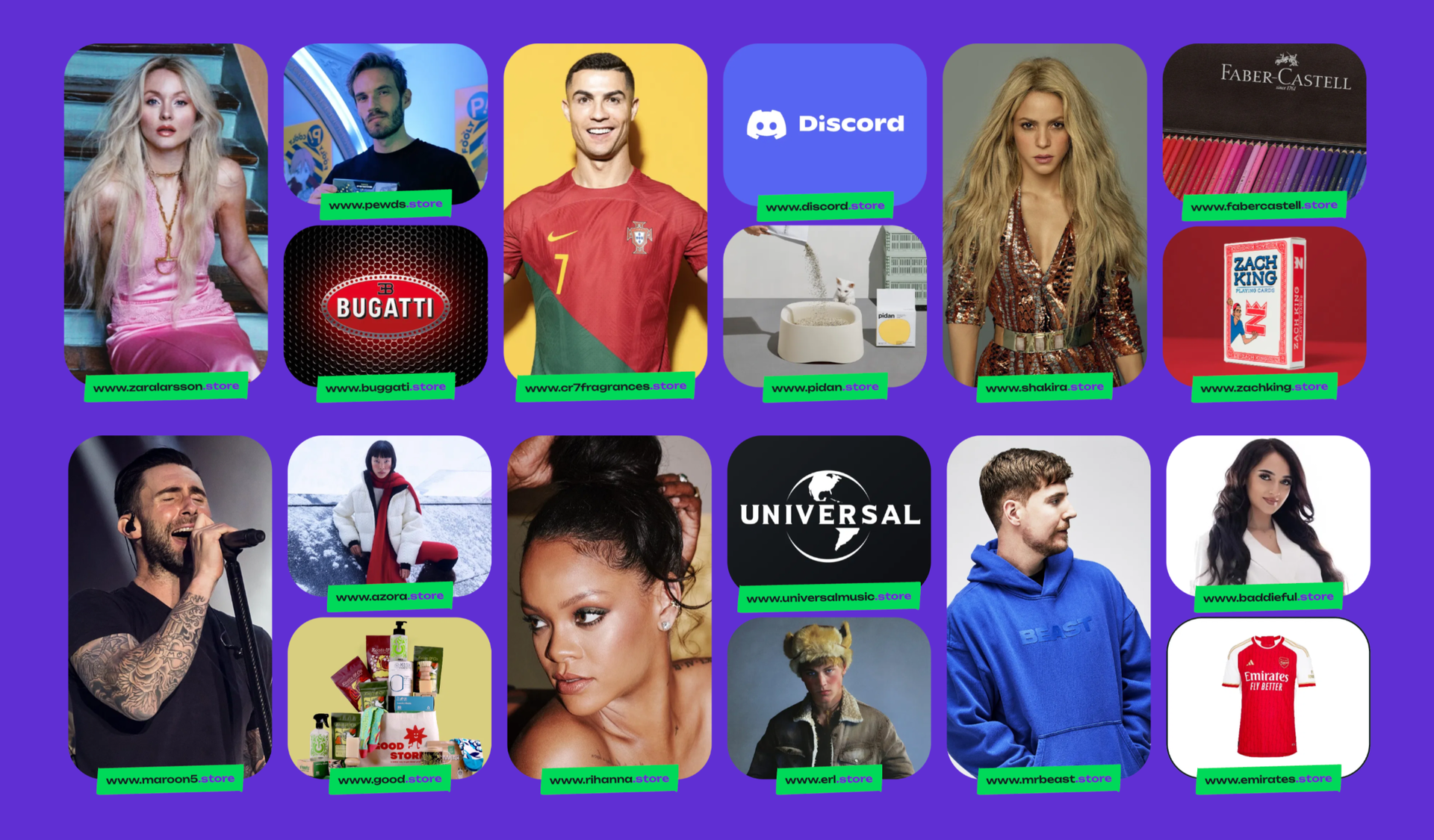
You can see that approach in get.store’s real-world examples. MrBeast uses mrbeast.store for merchandise, Shakira uses shakira.store, and Emirates uses emirates.store for its online retail presence. These are names with large, established audiences, yet each puts .store on their online stores. Emirates says it chose the extension because it is simple and direct and helps define its store identity. For a shopper, a familiar brand name paired with .store can make the purpose of the address easier to recognize. The brand still has to earn the customer’s trust through the store itself.
That clarity may help attract relevant clicks. It is different from an automatic search ranking boost. Google’s SEO Starter Guide says it generally does not care which generic TLD you use for ranking. Your product pages, useful content and technical setup matter for search visibility. The address can also help a shopper decide whether to click.
One piece of evidence is a 12-month experiment by Contrast Digital. It ran comparable stores on .store and .com. The .store version recorded 87% more organic clicks (623 versus 333) and 101% more search impressions (49,939 versus 24,822). Its paid ads recorded a higher click-through rate (10.34% versus 8.88%) and lower customer acquisition cost (£39.59 versus £44.95). .store commissioned this test. It covered one pair of stores, paid-ad spend differed, and Contrast could not establish the statistical significance of the acquisition-cost difference. The result is promising for this test, not a prediction of your store’s traffic or proof that Google favors the extension.
There is a commercial signal too. Wix’s analysis of nearly a million domain registrations found that ecommerce stores on .store earned 10% more revenue than those on .com and twice as much as those on .shop or .net. This is an association within Wix’s customer data, not evidence that adopting .store causes higher revenue. As Wix’s domain lead explained to TechRadar, sellers choosing an explicitly retail-focused address may already be especially clear about what they sell.
How do you make your domain name feel trustworthy?
Start with a name customers can connect to your brand. Say it aloud, type it on a phone and check that it matches the name on your products, social accounts and ads. Then make the store behind it easy to verify:
- Show real business details and a working support address.
- Explain shipping, returns and payment terms before checkout.
- Use a clear checkout that tells shoppers who will charge them.
- Keep the brand name and domain spelling consistent across channels.
- Choose a credible domain extension such as .store
- Use HTTPS to protect the connection, but do not treat the padlock as proof that a seller is legitimate. Fake stores use HTTPS too.
So, is .store trustworthy for an online seller? It is a brandable choice with a clear meaning, published abuse rules and performance data worth examining. Run the independent checks, choose a name that fits your brand, and build the kind of store a cautious customer can verify before paying.